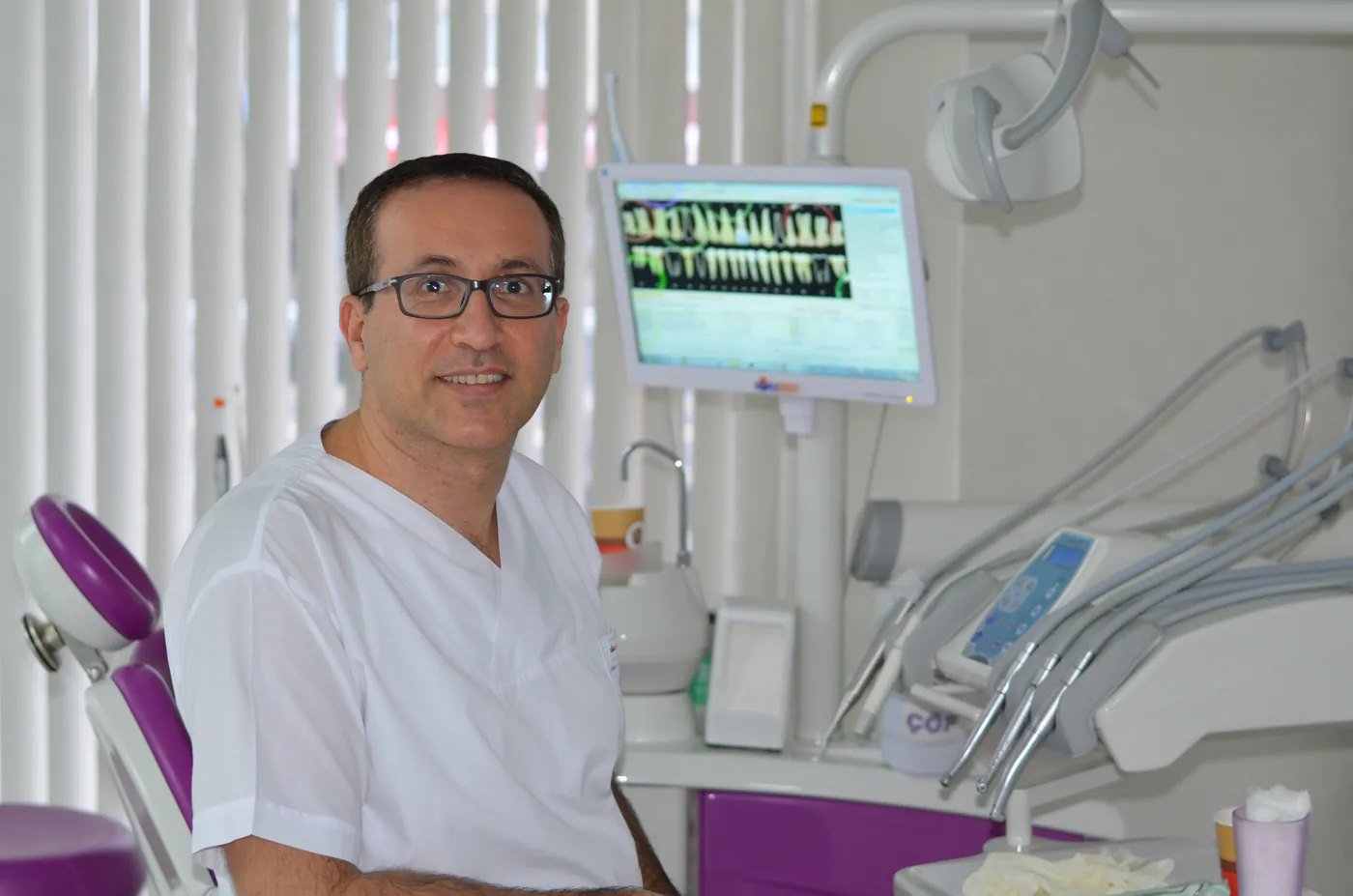
Crowning all of the teeth — often called full-mouth crown restoration — means rebuilding most or all of the teeth in the mouth with fixed restorations, that is with crowns. The goal is not simply a brighter smile. The real aims are to restore chewing function, to protect teeth that have lost a great deal of structure or that have fractured, and to keep the relationship between the teeth and the gums stable over the years. Unlike a single crown planned for one tooth, a full-mouth restoration requires the bite (occlusion) to be assessed as a whole and the way the upper and lower jaws meet to be re-balanced.
What Is a Crown, Exactly?
A crown is a fixed restoration that caps the visible part of a tooth and sits right down to the gum line. The dentist removes a controlled thickness of tooth tissue, takes an impression or a digital scan, and cements the restoration made in the laboratory onto the tooth. A crown has three jobs: to protect weakened tooth structure, to reduce the risk of fracture, and to re-establish aesthetics and function. For that reason a crown is not only a cosmetic cover; in many cases it is a protective treatment.
What Does "Covering All Teeth" Involve?
When full-mouth coverage is chosen, the treatment goes well beyond covering the top surfaces of the teeth. The process usually includes:
- Clinical and radiographic examination, with assessment of decay and gum health
- Preparing the teeth, removing as little tissue as the case allows
- Checking the bite and the jaw joint, and re-planning the vertical dimension of the face when needed
- Shade selection and smile design planning
- A trial period with temporary restorations to test both function and appearance
- Laboratory production (zirconia, metal-ceramic or lithium disilicate)
- Finishing: cementation, checking the fit of the margins, adjusting the bite and scheduling follow-up
The phrase "covering all the teeth" sounds like a single procedure, but it is in fact a planned restoration built from several connected stages. In that process it matters that patient and dentist decide together, and above all that it is made clear which teeth genuinely need a crown.
When Is Full-Mouth Coverage Clinically Indicated?
Full-mouth crown restoration is a decision that calls for caution, because prepared tooth structure does not grow back. The indication therefore comes from the condition of the teeth rather than from the patient's wish alone. The situations below may bring coverage of all the teeth, or of a large part of them, onto the agenda.
Extensive Loss of Tooth Structure and Multiple Fractures
Severe decay, large old fillings, repeated fractures and restorations that have worn out over the years all reduce the amount of sound tissue a tooth can rely on. At that point continuing with fillings is not always possible, because the remaining walls of the tooth are thin and may crack under chewing forces. Full coverage protects the tooth by encircling what remains.
Teeth That Have Had Root Canal Treatment
Root canal treatment removes the living tissue from a tooth and can make it more fragile over time. In back teeth that carry heavy chewing loads and have lost a lot of structure, a crown helps to prevent a vertical fracture. It is not correct, however, to crown every root-treated tooth automatically; the decision depends on how much tissue remains and where the tooth sits in the mouth.
Worn Dentition and Clenching or Grinding
Grinding or clenching at night (bruxism), acid erosion and an acidic diet thin the tooth surfaces over time. In advanced wear it is not only appearance that suffers: chewing efficiency and the jaw joint can be affected too. In these cases crowns alone may not be enough, and a protective night guard together with careful planning of the vertical dimension usually becomes part of the treatment.
Cases Planned Around Implant-Supported Restorations
When missing teeth are replaced with implants and the remaining teeth are also used as support, a single height, shade and contact-point scheme has to be built for the whole arch. In such cases a full-mouth approach lets implant crowns and natural teeth work in harmony. We discuss implant planning on our implant treatment page, and the replacement of many missing teeth at once in our article on implants for all teeth.
Severe Discolouration and Structural Colour Problems
In cases such as tetracycline-related staining, fluorosis, advanced enamel loss or old aesthetic restorations that have changed colour over time, whitening alone often does not give a sufficient result. These conditions are not only a cosmetic issue; they can also signal a structural weakness. The load-bearing capacity of the teeth is therefore assessed first, and the decision on restorations comes afterwards.
When Are Crowns NOT Needed?
Cutting sound, decay-free, well-aligned teeth that cause no aesthetic concern simply to make them whiter is not the right approach. In those teeth the structure is preserved, and more conservative options such as bleaching, thinner forms of restoration or orthodontic alignment take priority. Recommending full-mouth crowns to every patient cannot be defended medically; the indication is individual.
Crown, Veneer and Onlay: How Much Tissue Does Each One Remove?
There is no single restoration type for aesthetic and functional complaints. The choice is directly linked to how much tissue would have to be removed and how sound the tooth is.
What Is a Veneer?
A veneer is a thin layer placed on the front surface of a tooth only. It is often chosen for cosmetic corrections in the front teeth and requires less tooth tissue than a crown. To place a veneer, however, the tooth needs enough enamel and a suitable position; if a great deal of structure has been lost or the tooth is structurally weak, a crown that encircles the whole tooth may be needed instead. Porcelain veneers are therefore not automatically the "more conservative" choice — it depends on the indication.
Onlays and Partial Restorations
An onlay keeps part of the chewing surface of the tooth and replaces only the fractured or missing portion. The more sound tissue is preserved, the better the long-term durability of the tooth. A dentist's priority is therefore to evaluate the most conservative option available, and to consider a crown when it is genuinely required.
Crown Materials: Zirconia, Metal-Ceramic and Lithium Disilicate
The material is chosen according to aesthetic expectations, the position of the tooth in the mouth, the condition of the opposing teeth, the depth of the shade and the patient's habits. The table below compares the three most common options in general terms. It is not a ranking of "the best"; it is an honest summary of the strengths and weaknesses of each material.
| Criterion | Zirconia | Metal-ceramic | Lithium disilicate |
|---|---|---|---|
| Aesthetics and natural appearance | Metal-free with good light transmission; gives a natural look together with high strength. | The porcelain part is aesthetic, but it is opaque and the metal framework can cast a grey shadow. | High light transmission; can produce the most natural shade transitions in the front region. |
| Wear on opposing teeth | Shows a relatively low wear tendency; surface smoothness depends on the laboratory finishing. | The porcelain surface behaves close to natural enamel, though wear remains possible over time. | Controlled wear similar to zirconia; the quality of polishing is decisive. |
| Risk of fracture and chipping | High strength and often used in the back region, though no material is flawless. | The porcelain layer may be more prone to chipping; the metal framework limits fracture. | Good strength, though in some situations more sensitive to biting forces. |
| Visible metal | None. No grey line even at the margins. | A grey line can appear if the gum recedes or the porcelain is thin. | None. |
| Stain resistance | The surface keeps its shade with regular care; the effect of coffee, tea and smoking is limited. | The porcelain is stain-resistant; the metal margin is unaffected. | Stain-resistant; polishing should be refreshed if the surface becomes rough. |
| Cleaning and gum compatibility | Tight margins and a smooth surface; interdental brushes make care straightforward. | Cleans in a similar way; margin fit depends on laboratory quality. | Easy to clean; thin margins are sensitive to hygiene. |
| Typical use | Common in extensive restorations and in the back region. | A classic option for long spans and cost planning. | Chosen for front-region aesthetics and single-tooth restorations. |
In practice a mixed plan is often used: lithium disilicate for the front teeth and zirconia or metal-ceramic for the back teeth. Such combinations aim to look after appearance and strength at the same time.
The Digital Workflow: Scan, Temporaries, Try-In and Cementation
In full-mouth restorations much of the outcome is decided at the impression and planning stage. This process is increasingly digital: an intraoral scanner records the teeth and gums in three dimensions, the laboratory design is carried out on screen, and in some cases the shape of the restoration is reviewed digitally before it is ever tried in the mouth.
Planning and Preparation
In the first appointments the current state of the teeth, the bite, gum health and the patient's habits are assessed; if necessary, gum treatment and removal of decay come first. Where the vertical dimension will change, temporary restorations are worn for a period so that the new bite height can be tested.
How Many Appointments?
Full-mouth crown restoration is never completed in a single visit; depending on the extent of the work, gum condition and laboratory schedule it usually takes several appointments. A typical sequence is examination and planning, preparation and temporaries, digital impression and try-in, and finally finishing and cementation. In some cases an extra review appointment is needed for fine adjustment of the bite. For patients travelling from abroad the appointments can be concentrated into a single visit; that planning is covered separately in our international patients section.
Cementation and Finishing
In the final stage the fit of the margins and the contact points are checked, the bite is adjusted in detail and the surfaces are polished. Correct cementation and a correct bite adjustment are the two factors that most directly influence how long a restoration serves.
Gum Health and Oral Care With Many Crowns
Crowns replace natural tooth tissue, but the gums are still living tissue and need the same care as natural teeth. In a mouth with many crowns, hygiene habits are one of the most important factors determining how long the treatment lasts.
Daily Care
- Brushing twice a day with a soft brush and correct technique to remove plaque collecting at the crown margins
- Interdental brushes or floss between the teeth; the junctions around crowns matter especially
- An oral irrigator or a suitable mouth rinse as a support, as recommended by your dentist
- Regular use of a protective night guard if you clench or grind
- Avoiding very hard foods and habits such as biting pens, ice or fingernails
What to Expect Over the Years
Restorations do not fail on their own; problems are usually inflammation of the gum around the margin, wear related to biting habits, or in some cases chipping of the porcelain. Regular check-ups and professional cleaning once or twice a year are therefore essential. When signs such as gum recession, a deteriorating margin fit or toothache appear, early intervention is what keeps a restoration repairable. If your restoration sits on implants, see our article on implant aftercare for the details of implant maintenance.
Honest Limits and Alternatives
Full-mouth crown restoration, applied for the right indication, is a treatment that noticeably improves function and appearance; it is not, however, a limitless solution. Longevity depends on many variables: oral hygiene habits, parafunctions such as clenching or grinding, the material chosen, the suitability of the bite, the quality of the remaining tooth structure and regular follow-up. No dentist should therefore promise a specific number of years; guarantee language is not medically realistic.
When crowns are not required, alternatives worth considering include whitening procedures, composite restorations, orthodontic alignment, a protective night guard against tooth wear, and local solutions such as an implant for a single missing tooth. In teeth with extensive structure loss, a crown can be a last-resort way of preserving the tooth instead of extracting it. For a general framework on treatment planning and managing the process in Turkey, our guide on implant treatment in Turkey may be useful.
The most important point to remember is this: sound, healthy tooth structure cannot be recovered once it is removed. The dentist's task is therefore not to find teeth that could be crowned, but to plan the best result with the least tissue loss in the teeth that genuinely need it. In our clinic in Küçükçekmece this assessment is made individually for every patient; for personal planning details you can speak directly with Dt. Sertaç Kızılkaya. The clinic operates as Korudent Diş Polikliniği in Küçükçekmece / İstanbul.
Frequently Asked Questions
Is crowning all of the teeth really necessary?
Not for every patient. Sound, decay-free, well-positioned teeth are not prepared purely for aesthetic reasons; more conservative options are considered for them. Full-mouth coverage is generally considered in cases with widespread structure loss, fractures, advanced wear or a need for extensive restorations, and the decision is made after an individual examination.
Which is better, zirconia or metal-ceramic?
Both have strengths and weaknesses, and no single material is best in every situation. Zirconia contains no metal, so its light transmission is better, and it is often preferred in extensive restorations. Metal-ceramic is a classic option that has been used for many years, but a grey line may appear at the margin if the gum recedes. The choice depends on the position of the tooth and the aesthetic expectation.
How many appointments does a full-mouth crown restoration take?
It is not completed in a single appointment. The process usually consists of examination and planning, preparation and temporary restorations, a try-in stage, and finally cementation. The total number of visits varies with the extent of the work, gum condition and the laboratory schedule; the exact timetable becomes clear after the examination.
What does the cost of crowns depend on?
The cost cannot be expressed as a single figure. It is determined by the number of units to be restored, the material chosen, the laboratory work involved and any additional procedures required. Preparatory treatments such as gum therapy or root canal treatment can also add to the plan. A realistic assessment can only be made after an examination and the necessary imaging.
How long can crowns last?
A specific number of years cannot be guaranteed. Longevity is closely related to oral hygiene, clenching or grinding habits, the material selected, the suitability of the bite and regular check-ups. With good care, restorations can serve for many years, but that is an outcome dependent on maintenance rather than a guarantee.